
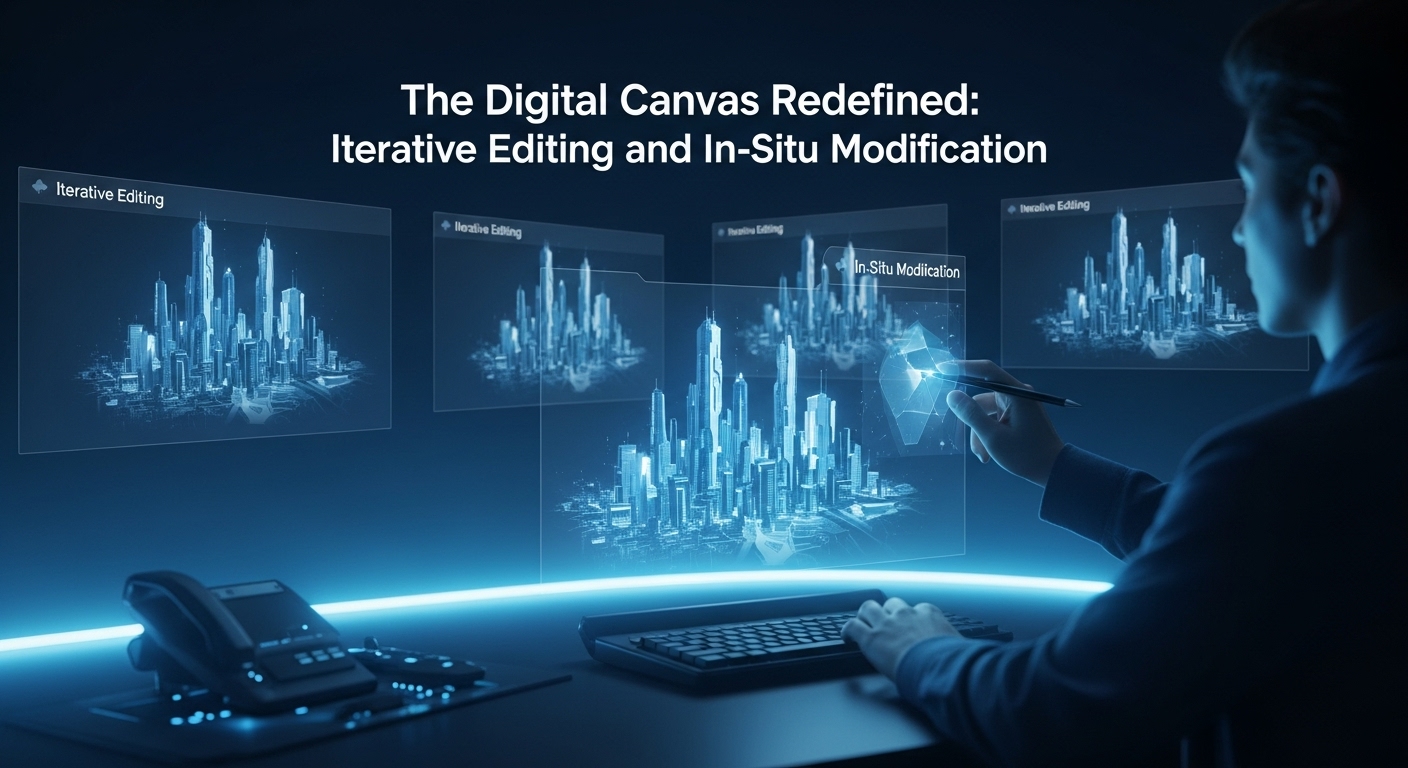
The Digital Canvas Redefined: Iterative Editing and In-Situ Modification
Beyond establishing initial consistency, the true evolution toward a collaborative AI partnership is most evident in the suite of features for iterative, in-situ image editing. This capability transforms the creative process from a rigid, often destructive cycle of regeneration into a fluid, constructive dialogue. Instead of discarding an almost-perfect image due to a minor flaw, the user can now act as a digital sculptor, directly modifying the generated “canvas” using simple, natural language commands. This represents a profound “workflow collapse,” integrating the distinct roles of creator, retoucher, and photo editor into a single, seamless action.
The Power of Conversational Refinement
The system’s editing tools operate on multiple levels of abstraction, from adding discrete objects to altering nuanced emotional expressions. This granular control is demonstrated through several key functionalities:
- Targeted Element Addition: A user can select a specific region of an image and instruct the AI to add a new element. For example, by highlighting the neck area of the “Astro” character, a user can simply type “add a bow tie and a party hat” “. The AI not only generates these objects but also intelligently composites them into the scene, correctly interpreting lighting, perspective, and style. This eliminates the need for external software and the technical skills associated with manual compositing.
- Nuanced Attribute Modification: Perhaps more impressively, the AI can interpret and execute commands related to abstract and emotional concepts. After generating an image of Astro, a user can request that the character “look a little more surprised” “. This demonstrates a sophisticated understanding of the subtle visual cues that constitute an expression—widened eyes, a slightly open mouth—and the ability to modify the image accordingly. This is a crucial development for any form of storytelling, advertising, or communication that relies on emotional connection.
- Context-Aware Inpainting: The system also exhibits a remarkable degree of contextual awareness. When asked to “add a cute cat sleeping on the sofa” next to the main character, the AI doesn’t just paste a generic image of a cat. It generates a cat that is stylistically consistent with the rest of the image, correctly positioned on the sofa, and rendered with plausible perspective and scale “. It understands the spatial and logical relationships within the scene, performing a task that would traditionally require careful masking, scaling, and lighting adjustments in a dedicated photo-editing program.
Workflow Collapse and the Obsolescence of “Round-Tripping”
The collective impact of these features is a dramatic reduction in creative friction and a collapse of previously siloed workflows. Consider the traditional process for making a simple change: a marketing manager generates an AI image but decides it needs a small addition. The standard workflow would be: 1) Download the image. 2) Send it to a graphic designer. 3) The designer opens it in a program like Adobe Photoshop. 4) The designer finds or creates the new asset (e.g., a hat). 5) They use selection tools and layer masks to composite the hat onto the character. 6) They adjust color, lighting, and shadows to make it look natural. 7) They save and export the new version. 8) They send it back for review. This multi-step, multi-person process, often called “round-tripping,” is slow, inefficient, and introduces communication overhead.
The new AI-driven workflow is: 1) Generate the image. 2) Select the area. 3) Type “add a hat.” The entire eight-step process is collapsed into a single action performed by one person in seconds. This is not an incremental improvement; it is an exponential leap in efficiency. It empowers a single user, who may have no technical design skills, to perform tasks that previously required a specialist. This drastically lowers the barrier to entry for professional-level image manipulation and accelerates the creative cycle from days or hours to mere minutes. Just as AI is transforming digital content creation across industries, this technology represents a fundamental shift in how creative work gets done.
The Rise of the “AI Art Director”: Redefining Creative Roles
The long-term consequence of this workflow collapse is a fundamental redefinition of roles within creative teams and a shift in the hierarchy of valuable skills. As the technical execution of tasks like compositing, retouching, and color correction becomes increasingly automated and accessible through natural language, the value of pure technical proficiency with specific software tools will diminish for a large class of common creative tasks. The bottleneck in the creative process is no longer the how—the complex manipulation of sliders, layers, and filters. Instead, the bottleneck becomes the what and the why—the clarity of the creative vision and the ability to articulate it effectively.
This shift elevates the importance of creative direction over technical implementation. The most valuable professional in this new paradigm will be the “AI Art Director.” This individual may not know how to use the pen tool in Illustrator, but they will possess a deep understanding of brand strategy, visual storytelling, and art history. Their core competency will be the ability to translate strategic goals into precise, evocative, and effective prompts and iterative feedback for the AI. They will guide the AI collaborator, asking it to “make the lighting more dramatic, like a Rembrandt painting,” or “shift the character’s expression from surprise to dawning realization” “. This approach to strategic brand development in Cypress shows how AI tools are reshaping creative workflows across different markets.
This disintermediates the purely technical designer for many routine tasks, freeing up highly skilled human designers to focus on more complex, high-concept work that still requires a human touch. The value chain is reordered: the strategist who can articulate the vision becomes more powerful, directly co-creating with the AI. This will necessitate a change in how creative talent is recruited, trained, and deployed within organizations, prioritizing conceptual and communication skills alongside—and in some cases, above—traditional software-specific expertise. Organizations looking to leverage these creativity tools will need to adapt their workflows to maximize the potential of human-AI collaboration.